

When you need OCR (and when you don't)
- Screenshots of text you can't select (a video frame, a chat, an error dialog).
- Photos of a printed page, a whiteboard, a sign, or a slide.
- Scans and faxes saved as JPG, PNG, or TIFF.
- Receipts and business cards you want to file as text.
How to extract text from an image
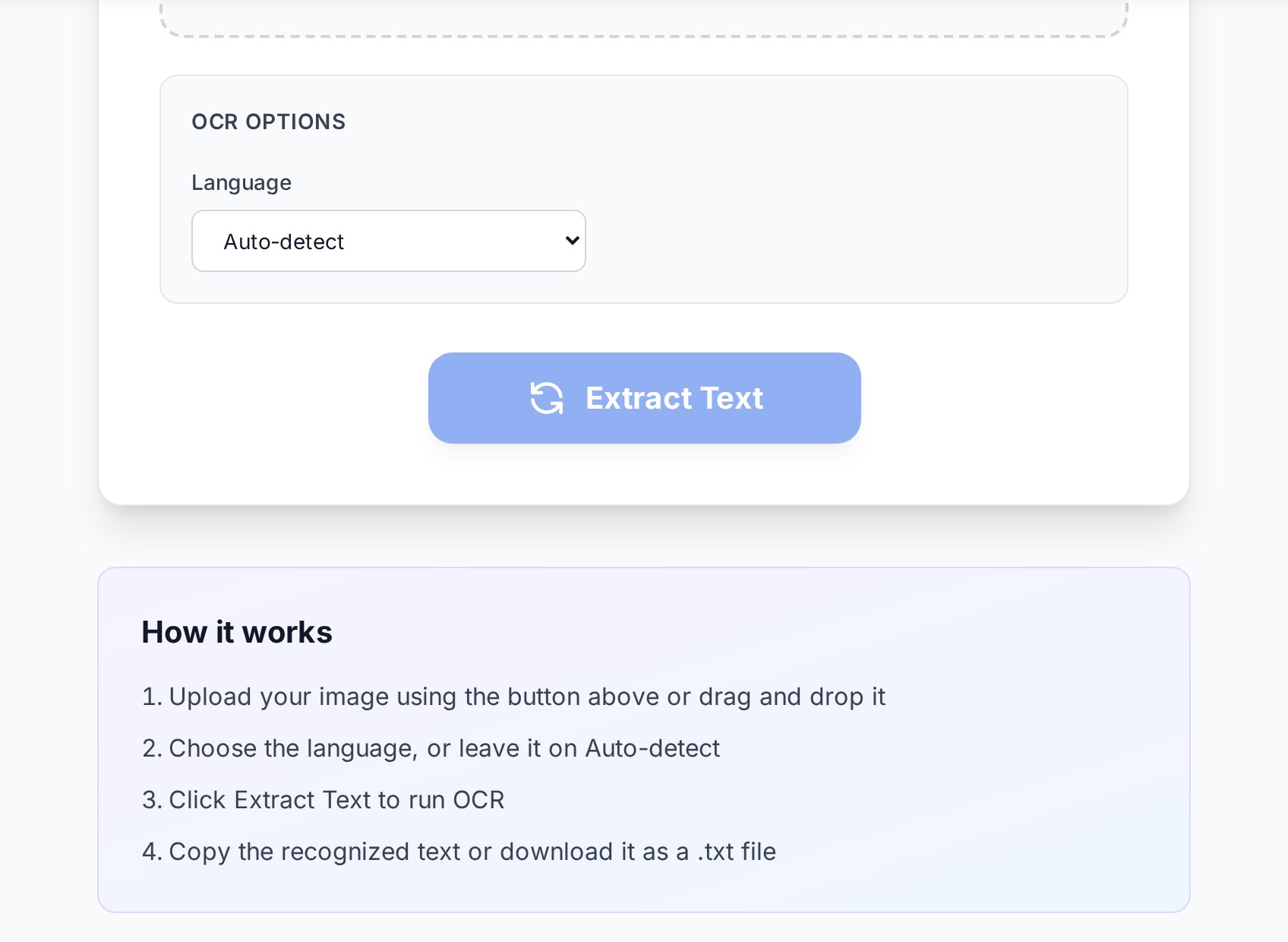
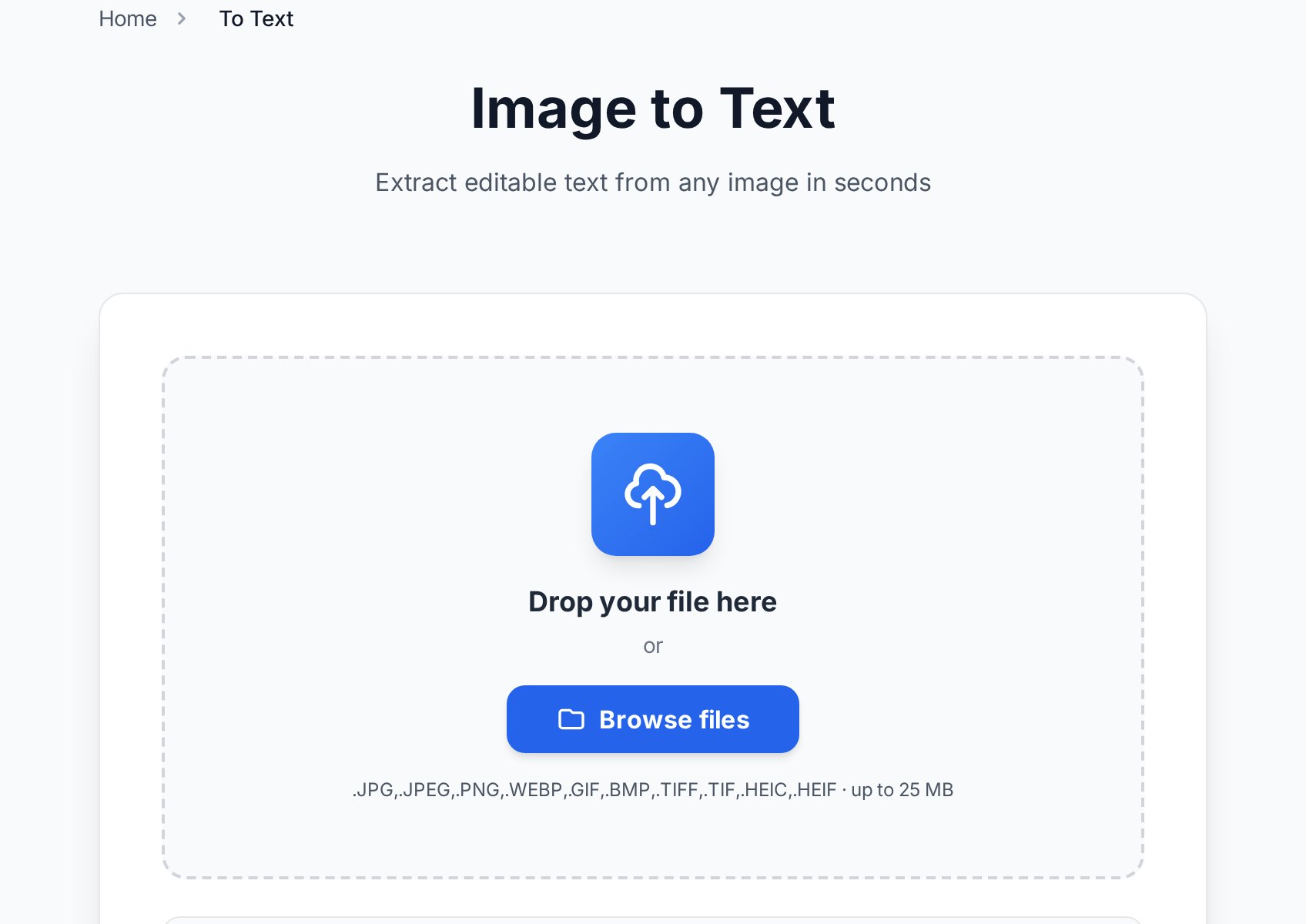
- Open the Image to Text tool and upload your image (JPG, PNG, WebP, HEIC, BMP, TIFF, or GIF). You can drag it straight onto the page.
- Pick the language of the text, or leave it on Auto-detect. Setting the language explicitly helps a lot for non-English or accented text.
- Click Extract Text. The recognised text appears on the page within a couple of seconds.
- Use Copy to grab it, or Download .txt to save it as a plain text file. Always give it a quick proofread before you rely on it.
Nothing is installed and the file is processed in a temporary session, then deleted - but see the confidentiality note in the FAQ for sensitive documents.
What actually affects accuracy
OCR quality is mostly decided by the image you feed it. Three things matter most:- Sharpness. Crisp, in-focus text reads cleanly. Motion blur and out-of-focus phone shots are the number-one cause of garbled output.
- Contrast. OCR works on the difference between ink and background. A faded photocopy or a low-light photo gives the recogniser too little to work with, even at high resolution.
- Language. An English-trained model misreads accented characters and unfamiliar words. Choose the correct language instead of Auto whenever you know it.
Resolution helps too: aim for text that's at least a few hundred pixels tall across a line. For scans, 300 DPI is the comfortable floor. Tiny footnotes in a low-resolution photo are where accuracy falls apart.
iPhone photos (HEIC) and other formats
Photos straight from a modern iPhone or iPad are usually HEIC/HEIF, not JPG. You don't need to convert them first - upload the HEIC and the tool decodes it directly. JPG, PNG, WebP, BMP, TIFF, and GIF all work the same way. For a multi-page TIFF or an animated GIF, the first frame is used.
Tips for a clean result
- Fill the frame with the text and crop out backgrounds, hands, and table edges - clutter confuses the layout detection.
- Shoot straight on. A page photographed at an angle keystones the letters and lowers accuracy; the tool straightens mild skew, but flat-on is best.
- Avoid glare and shadows. Even, diffuse light beats a bright window or a phone flash.
- For multi-column layouts, expect the text in reading order rather than reconstructed columns.
- Proofread the usual suspects: 0/O, 1/l/I, rn/m, and stray punctuation.
FAQ
Is it really free?
Yes. Extracting text from a single image is free, with no registration and no watermark on the output.
Which languages are supported?
17 languages, including English, Russian, German, French, Spanish, Italian, Portuguese, Polish, Turkish, Ukrainian, Hindi, Indonesian, Arabic, Chinese (Simplified and Traditional), Japanese, and Korean - plus automatic detection. For accented or non-Latin scripts, set the language explicitly for the best accuracy.
Can it read handwriting?
Sometimes, and not reliably. OCR is trained on printed type; handwriting accuracy ranges widely and cursive does worst. Block capitals - like a form filled in by hand - read far better than joined-up writing.
Why is some text wrong or missing?
Almost always the source image: blur, low contrast, small text, or the wrong language setting. Re-shoot sharper and better lit, choose the correct language, and the result usually improves dramatically.
Is it confidential?
The image is processed in a temporary session and deleted shortly after. Still, read the privacy policy before uploading sensitive material. For highly confidential documents - medical records, privileged legal files - prefer local OCR (such as Tesseract) over any web service.
Can I get the text as a Word document?
This tool returns plain text you can paste anywhere. If you specifically need a scanned PDF turned into a formatted Word file, use the PDF to Word converter with OCR instead.
Try it now
Stop retyping. Drop your screenshot or photo into the Image to Text tool, pick the language, and you'll have editable text in seconds - just give it a quick proofread before you use it.


