

Why your rotation keeps disappearing
PDFs store an orientation flag for each page inside the file structure. When you "rotate" inside Adobe Reader's free version, you're only telling the viewer how to display the page on your screen for this session. The flag in the file is untouched. Three things are happening behind the scenes:- Viewer-level rotation changes the rendering, not the data. Close the document and the override is gone.
- File-level rotation rewrites the page's orientation entry. Every viewer afterwards reads the new value.
- "Save As" in free Adobe Reader can save the file again, but it doesn't commit the view-only rotation. That feature is gated behind paid Acrobat.
If you can rotate but the change vanishes after closing, you almost certainly used a viewer-level rotate. Use a tool that rewrites the page orientation in the file itself.The behaviour shifted slightly in Adobe Reader DC versions 2019 and later: the rotate button is now buried under Tools > Organize Pages, where it looks like it should commit the change but still won't unless you pay. The free version explicitly tells you in a small footer message that "saving page rotations requires Acrobat Pro", which many users never read. The fastest fix is a browser-based rotator that re-encodes the file directly. You can rotate PDF online in about ten seconds without installing anything.
Step-by-step: rotate every page 90 degrees
This is the right approach when an entire scan came out sideways, or when someone exported a landscape report as portrait by accident.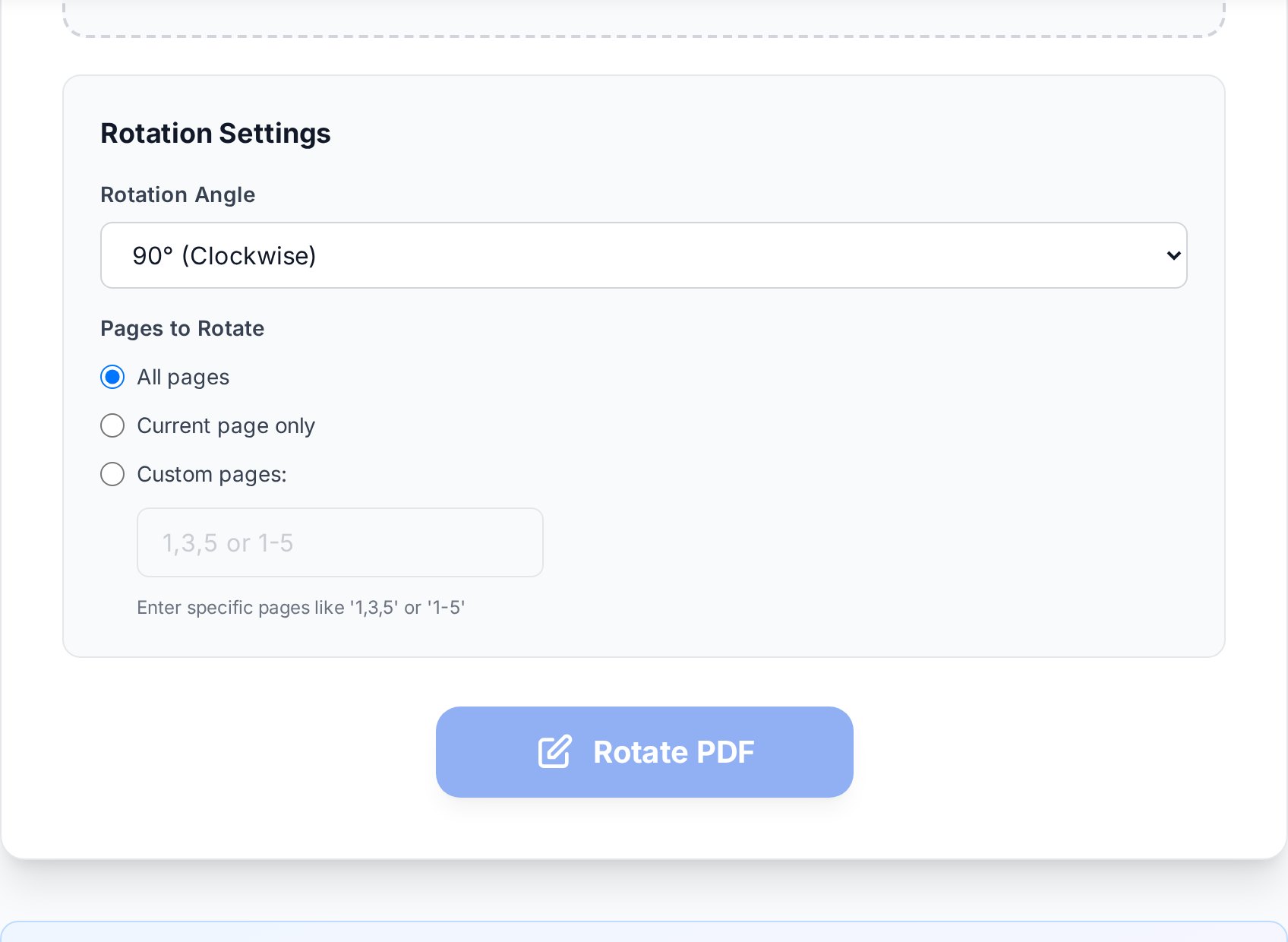
- Open the rotate tool and drop your PDF in. Files stay on the upload session only as long as needed for processing.
- Pick a direction. 90 degrees clockwise fixes most sideways scans. 180 degrees handles upside-down documents from auto-feeders that grabbed the page wrong way up.
- Apply to all pages. The tool rewrites the orientation flag for every page in one pass.
- Download the new file. Open it in any viewer to confirm.
contract_rotated.pdf so you don't overwrite the original by mistake. Keeping the original is cheap insurance if the rotation went the wrong way - and rotations going the wrong way is the single most common "I wasted ten minutes" report from anyone using a rotate tool for the first time. Two clockwise turns equals one counter-clockwise turn, so the recovery is fast, but only if you still have the source.
Step-by-step: rotate only specific pages
Mixed-orientation PDFs are common when a scan batch contains both portrait letters and a landscape spreadsheet, or when someone merged files from different sources.- Upload the PDF. Look at the thumbnail grid to identify which pages are wrong.
- Select pages by number. Most tools let you rotate page 3, 7, and 9 independently rather than the whole file.
- Set the rotation direction per page if needed. A receipt scanned upside down on page 5 might need 180 degrees while page 7 needs 90 clockwise.
- Apply and download. Verify the thumbnails show the corrected orientation before you ship the file.
Common scenarios
Sideways scanned receipts
Flatbed scanners and phone-camera apps often capture small receipts in the wrong orientation. A 90-degree clockwise rotation usually fixes them. If you scan a stack with mixed orientations, do them all at once and rotate per page rather than rescanning. Thermal-paper receipts (the kind that fade) are particularly prone to coming out 180 degrees off because they're often stacked print-side down for protection.Mobile photos converted to PDF
iOS and Android sometimes encode the photo orientation in EXIF metadata that the PDF converter ignores. The result is a portrait photo saved as a landscape PDF page. File-level rotation is the cleanest fix. Worth knowing: this got noticeably worse around iOS 14, when Apple changed the default photo format from JPEG to HEIC. Older PDF tools that strip HEIC orientation tags during conversion produce sideways pages every time. Setting the camera back to "Most Compatible" before shooting solves the problem at source.Mixed landscape and portrait reports
Annual reports and pitch decks often combine portrait text pages with landscape charts. If a converter forced everything to portrait, you might need to rotate the chart pages 90 degrees so they read correctly when scrolled or printed in landscape. Investor decks built in PowerPoint and exported to PDF are a common offender; PowerPoint's "Print to PDF" path treats the whole file as one orientation rather than per slide.Forms received as faxes
Many medical and legal forms still arrive by fax, which means they pass through a printer that may have rotated the page to fit the paper. The signature block ending up at the top is a clue - rotate 180, save, send back through the same fax line if you must.Verifying the rotation stuck
Before you send the file off, do a 30-second sanity check:- Reopen the rotated PDF in a viewer you didn't use to rotate it. Chrome, Preview on macOS, and Edge all read the file differently than Acrobat.
- Email the file to yourself and open the attachment from a phone. Mobile viewers respect the file-level orientation flag and will instantly show whether the change is real.
- Run a print preview. The preview reflects the file orientation, not the viewer override, so a sideways preview means the rotation didn't save.
- Check the thumbnail panel in your file manager. Both Windows Explorer and macOS Finder show the file-level orientation in their preview pane. If the thumbnail there matches what you expected, the rotation committed.
Bulk rotation tips
When you're about to combine several PDFs, fix orientations before you merge. Otherwise, you'll have to identify rotated pages inside a 200-page bundle, which is much slower than fixing each source file individually. Reverse advice applies to scans straight from a duplex feeder. If every other page came out upside-down because the scanner flipped the back side wrong, rotate first, then merge them into a single file. You'll save a step compared with merging then trying to rotate alternate pages inside the combined PDF. One more thing: rotation doesn't change the underlying image data, just the orientation entry. So you don't lose quality, and the file size stays effectively the same (give or take a few bytes for the rewritten metadata). That makes rotation safe to run on legal exhibits and evidence files where the integrity of the underlying bitstream matters - the data hash will change because metadata changed, but the page content is byte-identical. Print-driver gotcha worth flagging: some enterprise printers ignore the PDF orientation flag and use their own auto-rotate logic based on the longest text run. If your rotated PDF prints sideways from the office Konica or Xerox, the printer is overruling you. Check the print dialog for an "Auto-rotate" or "Orientation: From file" option and switch it to manual.FAQ
Why does my PDF look correct in Chrome but sideways in Adobe?
Chrome sometimes auto-corrects orientation based on text-direction heuristics, while Adobe respects the literal page-orientation flag in the file. If the two viewers disagree, the file-level flag is wrong even though Chrome hides the problem. Rotate the file properly so both viewers agree.
Can I rotate just one page in a multi-page PDF?
Yes. Use a tool that lets you select pages individually, or open the file in a page-organizer view. Pick the pages you want to rotate, choose a direction per page, and export. The pages you didn't select stay untouched.
Will rotating reduce the PDF's quality?
No. Rotation only changes the orientation entry in the file metadata. The image and text data are not re-encoded, so there's no quality loss and the file size is essentially unchanged.
Why won't my rotation save in Adobe Reader free version?
Free Adobe Reader supports only viewer-level rotation. Saving the file doesn't commit the rotation to disk. Permanent rotation is a paid Acrobat feature, or you can use a free browser-based tool that rewrites the orientation flag directly.
Can I rotate a password-protected PDF?
You need to supply the password first. Most online rotators prompt for it when an encrypted file is uploaded. If you don't have the password, you can't legitimately modify the file. If you own the document and forgot the password, that's a different (and unfortunate) recovery problem.
Try it now
Stop fighting the viewer. Open the rotate PDF tool and commit the orientation to the file in one pass, or browse all PDF tools if you also need to merge or reorder while you're at it.


